
Light tower knowledge · 03
Mast height, lamp type
and how many watts.
Three numbers decide whether a light tower is right for a site: how high the heads sit, what kind of lamp they are, and how much power the whole thing draws. Here is what each one actually buys you — and where the trade-offs sit.
Height buys area, not brightness. Every extra metre of mast throws light further but thins it out — doubling the height spreads the same output over four times the ground. Choose the mast for the shape of the site, then choose the lamp set for the lux the job needs, then check that the engine can carry that load.
Per watt, LED wins clearly. Per unit at the wattages we build, the 4,000 W metal-halide set still puts out roughly 1.8 times the light of the 1,600 W LED set. That is the real choice, and it is not the one the brochures usually frame.
01 — The numbers
The three numbers and what they buy
A light tower is a lighting scheme on wheels, and like any lighting scheme it is chosen from the ground up rather than from the catalogue down. The three decisions interact: raise the mast and you light more ground, but each square metre gets less light, so you either accept a dimmer site or pay for more lamp wattage — which costs fuel, engine size and money.
- Mast height sets the diameter of useful coverage and how much obstruction the beam clears. It is a function of the site, not of taste.
- Lamp type sets lumens per watt, colour, restart behaviour and how much of the maintenance budget goes to lamps.
- Total lamp power sets the engine, the fuel bill and whether the unit can still be towed by the vehicle your team actually has.
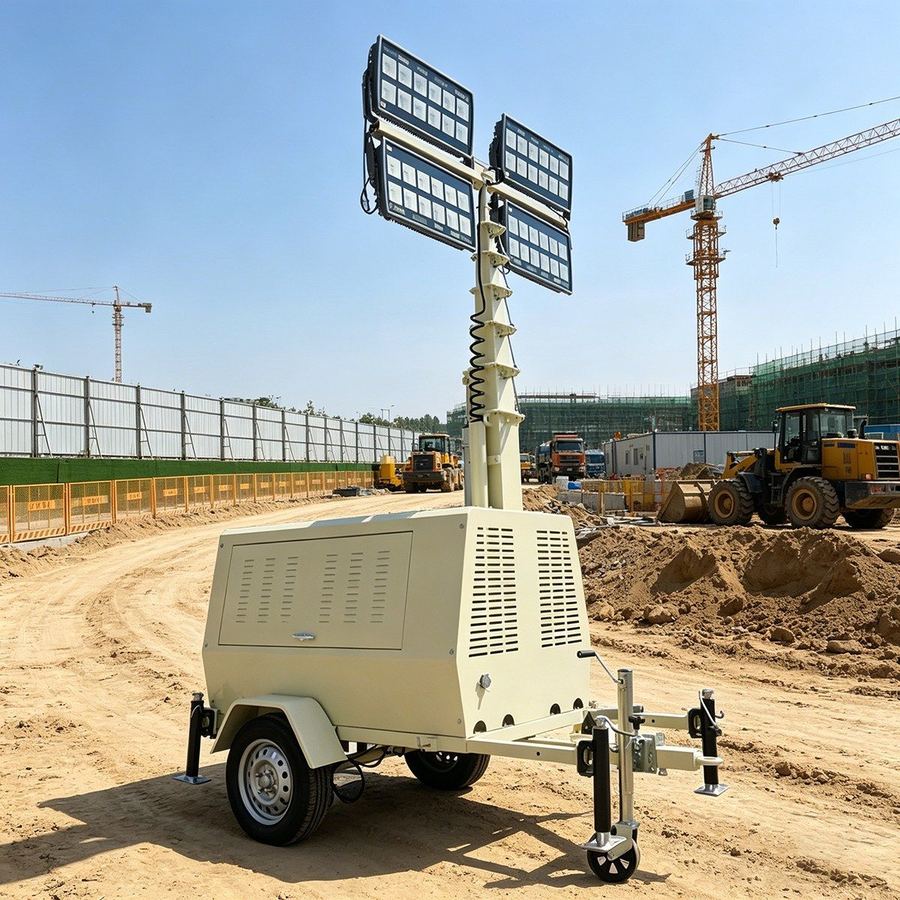
02 — Height
Mast height: the geometry nobody puts on a datasheet
Light falls off with the square of distance. Put a lamp at 5 m instead of 9 m and the same lamp gives you roughly three times the illuminance directly below it — but it covers less than a third of the ground, and it hits every obstacle at chest height instead of clearing it. That is the whole argument in one sentence: low masts are brighter and narrower, high masts are dimmer and wider.
The useful coverage diameter is roughly 2 × height × tan(half the beam angle). Our heads use wide distribution, so in round numbers a 120° beam gives:
| Tower | Mast | Useful diameter | Best for |
|---|---|---|---|
| FZMDTC-1000B9 m · 3-section hydraulic | 9 m | ≈31 m | Pours, large compounds, anything with stacked material |
| FZMTC-1000B7 m · manual | 7 m | ≈24 m | Roadworks, medium laydown areas |
| FZM-1000B5 m · hand-push | 5 m | ≈17 m | Trenches, footways, one work face at a time |
Two practical notes the table cannot carry. First, above about 7 m the mast becomes the structural story of the unit: it needs a hydraulic lift, a heavier base and proper stabilisers, which is why our 9 m model weighs 1,000 kg and the 7 m weighs 420 kg. Second, wind is a real limit — a mast left up in a storm is how towers fall over, whatever the brochure says. The mast comes down at the end of the shift on an exposed site.
03 — Lamps
Metal halide or LED, honestly compared
Both are in production here and both still sell, for good reasons. The comparison that matters is not LED versus metal halide in the abstract, it is this 4 × 400 W head set against this 4 × 1,000 W head set, on the same mast, behind the same engine.
| 4 × 1,000 W metal halide | 4 × 400 W LED | |
|---|---|---|
| Lamp load | 4,000 W | 1,600 W |
| Typical lamp efficacy | 90–105 lm/W | 120–150 lm/W |
| Total lumens, roughly | ≈400,000 lm | ≈220,000 lm |
| Diesel at full output | ≈1.9 L/h | ≈1.1 L/h |
| Restart after a power cut | 3–10 min | instant |
| Rated lamp life | ≈6,000–12,000 h | ≈30,000–50,000 h |
| Colour | warm, slightly golden | neutral white, higher CRI |
Read the third row against the first and the whole argument appears. LED is about 1.4 times more efficient per watt, but it is carrying 40% of the wattage, so the head set gives you a bit over half the light for 40% of the fuel. If a site needs the maximum lit area from a single trailer, metal halide still does that more cheaply up front. If a site runs every night for years, the lamp life and the fuel line usually decide it for LED.
The difference crews notice most is not brightness at all: it is restart time. An interruption on a metal-halide tower blacks the site out for several minutes while the lamps cool and restrike. On a pour, or on a lane closure with traffic moving past, that gap is the whole reason people specify LED.
04 — Power
Power: when the load picks the engine
The engine is sized around the lamp load plus auxiliaries, with headroom. Our rule of thumb is (lamp watts + 300 W) ÷ 0.85: the 4,000 W heads need about 5 kW, the 1,600 W heads about 2.2 kW, so the same 8.4 kW Quanchai will carry either — but it carries the small load badly, at a quarter of its rating, which is exactly where specific fuel consumption is worst. That is why the LED saving is 45% rather than 60%.
Power also decides the smallest units. The 5 m hand-push runs a 4.5 kW engine behind 4 × 400 W heads and carries 12.5 litres — a shift and a half of fuel, refuelled by hand. It is the right answer for a footway trench and the wrong answer for a compound, not because it is weak but because somebody has to walk out and fill it twice a shift.
05 — Briefs
Six briefs, six answers
| The brief | Mast | Lamp set | Model |
|---|---|---|---|
| Night pour, tower crane on siteneeds area and no restart gap | 9 m hydraulic | 4 × 400 W LED | FZMDTC-1000B-LED |
| Quarry face, maximum outputdust, vibration, long throws | 9 m hydraulic | 4 × 1,000 W metal halide | FZMDTC-1000B |
| Lane closure, urbannoise complaints, short set-up | 7 m manual | 4 × 400 W LED | FZMTC-1000B |
| Footway trenchone face, moved twice a shift | 5 m hand-push | 4 × 400 W LED | FZM-1000B |
| Compound with no fuel supplyrun every night, months | 9 m manual | 4 × 200 W LED + 1.6 kW PV | FZMT-S1600 |
| Hire fleet, one SKUfuel card, mixed sites | 9 m hydraulic | 4 × 400 W LED | FZMDTC-1000B-LED |
06 — Before we quote
What we ask before quoting
If you can answer these six, the quotation will be right the first time. If you cannot, we will still quote — but we will tell you which numbers we guessed.
- How many hours a night, and how many nights a year?
- What has to be lit — an area, a line, or a single work face?
- What is on the ground: sand, mud, asphalt, concrete? Stabilisers need something to bite.
- What tows it: a pickup, a flatbed, or a container of units for a fleet?
- Is there fuel on site, and what does a litre cost delivered?
- Is anyone working or living within earshot? That single question decides diesel or solar.
07 — Questions
Questions we get asked
Is a higher mast always better?
No. A higher mast spreads the same output over more ground, so the site gets dimmer unless you add lamp power. On a narrow trench a 5 m hand-push puts more light on the work than a 9 m tower standing further away, and it clears the fence line less — which is the trade you are making.
How much light does a 9 m light tower actually put out?
Around 400,000 lumens with four 1,000 W metal-halide heads, or about 220,000 lumens with four 400 W LED heads. What reaches the ground depends on the beam, the mast height and what is in the way — ask us for the layout for your site rather than a single headline figure.
Can I upgrade a metal-halide tower to LED later?
Yes, on the same mast and wiring. The ballast comes out and the engine load drops from about 5 kW to about 2 kW. Send us the model code and we will confirm the head set, mounting and whether the existing mast cable is rated for the new load.
What about glare on a road or a neighbouring property?
Glare is a positioning problem before it is a lamp problem. Keep the heads off eye-level sightlines, aim the outer pair down towards the work face rather than across the road, and on a residential site consider the solar tower with its lower output and silent engine bay.
Send us the site,
we will send the layout.
Tell us the area, the hours and what is on the ground. We will come back with the mast height, the lamp set, the model code — and the fuel figure for a night of it.
- Lumen and efficacy ranges are typical published figures for industrial metal-halide lamps and LED floodlights; the totals are four-head sums, not photometric measurements of a lit site. Ask for the lamp datasheet with any quotation.
- Coverage diameters are geometric: 2 × height × tan(half beam angle) at 120°, before obstructions and without any illuminance target.
- LED lighting, U.S. Department of Energy — efficacy and rated life.
- Directive 2006/42/EC on machinery, EUR-Lex — the directive our CE marking is declared against.