
Light tower knowledge · 06
What that certificate
actually certifies.
CE, SGS, ISO, High-Tech Enterprise — four documents that get mixed into one pile of paper in a tender package. They mean four different things, and only one of them is about the machine itself.
CE is the manufacturer's own declaration that the machine meets the directives that apply to it — it is a legal statement, not a test report. SGS verification is a third party confirming that the declaration is supported by test evidence. ISO 9001 / 14001 certify how the company is managed, not what the machine does.
What a buyer should actually read is the model list on the page. A certificate that does not name the code you are buying does not cover it.
01 — Three kinds
Three kinds of paper
| Document | Issued by | Speaks about |
|---|---|---|
| EU Declaration of Conformity | The manufacturer | One machine type, against named directives |
| CE mark on the plate | The manufacturer | The same declaration, in one symbol |
| Third-party verification (SGS et al.) | A testing house | That the declaration is supported by test reports |
| ISO 9001 / ISO 14001 | An accredited certification body | The company's management system |
02 — CE
CE: what it means, and what it does not
For a machine like a light tower, CE marking is a self-declaration. The manufacturer assesses the machine against the applicable rules, compiles a technical file, and signs a Declaration of Conformity naming the directives and standards used. There is no inspector who hands out a CE certificate — which is exactly why the technical file, and a testing house willing to verify against it, is the part worth asking for.
The directives that normally apply to one of our towers:
- Machinery — Directive 2006/42/EC today. It is being replaced by Regulation (EU) 2023/1230, which applies from 20 January 2027; a machine placed on the market after that date is declared against the regulation, not the directive.
- Electromagnetic compatibility — Directive 2014/30/EU, because the tower carries a generator, a controller and lighting drivers.
- Outdoor noise — Directive 2000/14/EC, for equipment used outdoors, with a guaranteed sound power level on the plate.
- Engine emissions — Regulation (EU) 2016/1628 (Stage V) for non-road mobile machinery, if the engine is in scope and the unit is sold into the EU.
A CE mark without a Declaration of Conformity behind it is decoration. The declaration is the document that names the model, the directives, the standards and the person who signed for them.
03 — SGS
The SGS letter, line by line
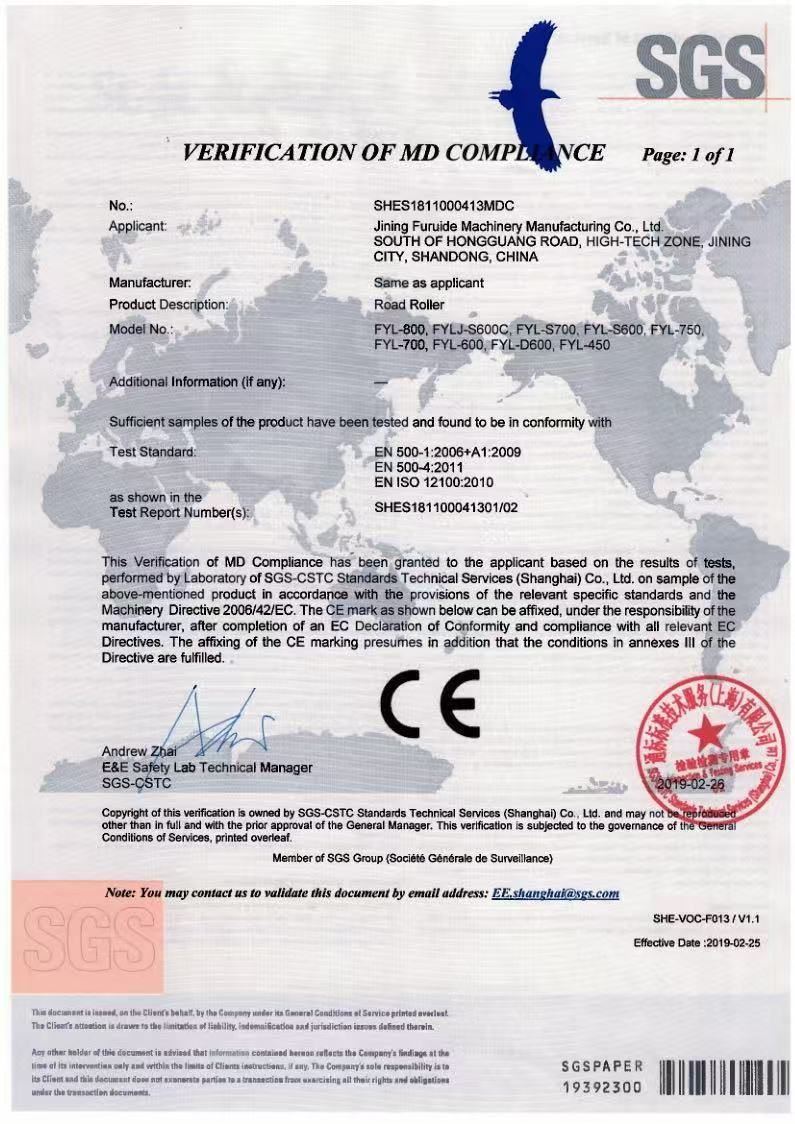
A verification letter from a testing house does one job: it says that an independent body has seen the test reports and considers the declaration supported. Read it in this order.
- The letter number and date. Ours is SHES1811000413MDC, effective 25 February 2019. A number you can quote back to the issuing office is worth more than a logo.
- Applicant and manufacturer. They should be the company you are buying from, at the address on the invoice.
- Product description and model list. This is the heart of it. Our roller letter names nine model codes; the light-tower letters name the tower codes. If your model is not on the list, the letter does not cover it.
- Test standards. Ours cites EN 500-1:2006+A1:2009, EN 500-4:2011 and EN ISO 12100:2010 — the machinery safety and risk-assessment standards for that product family.
- Test report numbers. The reports the letter is based on. Ask for the reports themselves if the order is large.
04 — ISO
ISO 9001 and ISO 14001
These certify a management system: that the company has documented processes for quality (9001) or environmental management (14001), and is audited against them. They tell you something real about how consistently a factory works. They tell you nothing about the light output of a particular tower.
Both are worth having as a buyer, for a specific reason: they are the difference between "this batch was good" and "there is a process that makes the next batch the same".
05 — Before you buy
What to ask any supplier for
- The Declaration of Conformity, with the model code you are buying on it.
- The model list on any third-party verification letter — check your code appears.
- EMC and electrical test reports for the unit, if the buyer's engineer asks for them.
- The engine emission certificate (Stage V, EPA Tier 4, or whatever the destination market requires) naming the engine model actually fitted.
- The guaranteed sound power level, if the site has a noise limit.
None of that is unreasonable to ask for, and a manufacturer who cannot produce the first two quickly is telling you something.
06 — Limits
What a certificate cannot tell you
It cannot tell you the lux on your site, whether the mast will survive your wind, whether the engine will start at −15 °C, or how the unit behaves in year four. Those are engineering and experience questions, and the honest answer is that they are answered by the specification, the test sheet and the reference list — not by a logo on a page.
Which is why the useful question in a tender is not "are you CE certified" — everybody says yes — but "send me the declaration, the model list on it, and the test sheet for the unit you would build for me."
07 — Questions
Questions we get asked
Is a CE certificate the same as a CE mark?
No. The mark goes on the machine; the Declaration of Conformity is the document behind it. For most machinery there is no "CE certificate" issued by an authority at all — the manufacturer declares, and third-party verification is separate and voluntary.
Does a certificate cover every model I might order?
Only the models it names. Our letters list model codes explicitly, and a new code needs its own coverage. If your model is not on the list, ask for the letter that covers it — that is a reasonable request, not a difficult one.
What changes for the EU machinery regulation in 2027?
Regulation (EU) 2023/1230 replaces Directive 2006/42/EC and applies from 20 January 2027. Declarations will cite the regulation instead of the directive, and the technical file requirements are tighter — including on software and digital documentation. If you are buying for delivery after that date, ask which framework the declaration uses.
Do you provide certificates for countries outside the EU?
We provide the EU documents plus engine emission evidence for the destination market, and we will tell you plainly when a local approval is the buyer's responsibility rather than ours. Ask before you order, not after the container lands.
Ask for the paperwork
with the quotation.
Tell us the model code and the destination country. We will send the declaration, the verification letter that names your code, and the engine emission evidence the market requires.
- Directive 2006/42/EC on machinery, EUR-Lex.
- Regulation (EU) 2023/1230, EUR-Lex — the machinery regulation that applies from 20 January 2027.
- Directive 2014/30/EU on electromagnetic compatibility, EUR-Lex.
- Regulation (EU) 2016/1628, EUR-Lex — emission limits for non-road mobile machinery (Stage V).
- Certificate details quoted above are read from our own SGS verification letter, not paraphrased from a catalogue.